


MARVEL Tōkon: Fighting Souls Review
- Matthew Rondina

- Aug 13
- 6 min read
MARVEL Tōkon: Fighting Souls combines spectacular anime-inspired visuals with accessible 4v4 combat, an entertaining comic-book campaign and plenty of depth.

Marvel fighting games have always held a special place for me, which made MARVEL Tōkon: Fighting Souls one of my most anticipated releases of the year. My early hands-on preview session at PlayStation Canada headquarters showed plenty of promise, but the finished game confirms Arc System Works has created more than a flashy crossover. Its escalating team battles, striking reinterpretations of familiar characters and flexible combat systems give Tōkon an identity all its own. After playing the preview build, open beta, and now diving into the final release, this is one Marvel fight I am happy to keep coming back to.

MARVEL Tōkon: Fighting Souls review details
Platforms: PlayStation 5 and PC
Reviewed on: PlayStation 5 Pro
Developer: Arc System Works
Publisher: Sony Interactive Entertainment
Genre: Fighting
Modes: Single-player, local multiplayer and online multiplayer
ESRB rating: T for Teen

Episode Mode brings Marvel Comics to Life
Episode Mode is the centrepiece of Tōkon’s single-player experience. Its story revolves around “the Champion,” a cosmic being who arrives on Earth in search of the ultimate battle. Five newly formed teams must enter his tournament and prove that Earth is worthy of survival.
The campaign follows the Fighting Avengers, Unbreakable X-Men, Amazing Guardians, Knights of Doom and Samurai Outriders through five parallel stories. Each episode shows how its team comes together before confronting rival squads, the mysterious Promoter and eventually the Champion himself.
What elevates the story is the involvement of Kieron Gillen, the acclaimed comic-book writer behind Marvel series including Uncanny X-Men, Young Avengers, Eternals and Immortal X-Men.
"What elevates the story is the involvement of Kieron Gillen, the acclaimed comic-book writer behind Marvel series including Uncanny X-Men, Young Avengers, Eternals and Immortal X-Men."
Gillen and the Arc System Works narrative team wrote all five episodes, giving the campaign narrative arc to someone who already understands Marvel’s personalities and relationships. I felt this almost immediately; it felt similar to the joy of discovering a new comic book, but in fighting-game form.

The larger tournament plot is familiar fighting-game territory, but Gillen finds humour and personality inside it. Doctor Doom is as arrogant as he should be, Robbie Reyes’ struggle with Ghost Rider receives some welcome attention, and the stranger team combinations produce entertaining exchanges. The stories also work as introductions for lesser-known characters such as Danger and Peni Parker.
Rather than relying on character models standing around between battles, Episode Mode unfolds through fully voiced motion comics, playable fights and occasional anime-style cinematics. Each team is illustrated by a different artist: Hiro Mashima handles the Fighting Avengers, Emanuela Lupacchino draws the Unbreakable X-Men, Betten Court tackles the Amazing Guardians, Mike Deodato illustrates the Knights of Doom, and Yusuke Osawa brings the Samurai Outriders to life.
That changing artwork gives every campaign its own personality. The structure becomes predictable after several episodes, but the writing, voice acting and visual variety kept me invested the entire time.
"The structure becomes predictable after several episodes, but the writing, voice acting and visual variety kept me invested the entire time."
It’s not as expansive as Street Fighter 6’s World Tour, yet it feels much more carefully authored than a traditional arcade ladder.

More Ways To Play Solo in MARVEL Tōkon: Fighting Souls
Episode Mode is only part of the solo package, and I was excited to see this as someone who likes to dive into single-player modes with my fighters first. All-Star Arena offers branching arcade-style challenges, while Survival introduces Soul Cards that provide roguelike-inspired buffs between fights. Arcadia Rumble turns the customizable lobby avatars into a lighthearted party mode. It is more of a diversion than a long-term attraction, but it adds another way to play locally or online.

4v4 Battles That Grow in Intensity
Tōkon’s defining idea is its 4v4 format, but matches do not begin with eight characters filling the screen. Both teams start with a smaller group, with additional teammates joining through new rounds, wall breaks and stage transitions. By the final stretch, the fight has naturally escalated into a full Marvel team-up.
Every squad shares one health bar, which means you can concentrate on learning a favourite fighter while treating the remaining characters as assists. I liked this design decision because things didn’t get completely overwhelming at first. More experienced players can build entire strategies around team order, assist properties, crossovers, and combo extensions. The Assemble and Skill gauges add another layer of resource management, eventually opening the door to spectacular team attacks involving the entire roster.

MARVEL Tōkon: Fighting Souls Features Excellent Roster Variety
The 20-character launch lineup offers plenty of variety. Wolverine is a relentless close-range fighter, Iron Man controls space with repulsor attacks, Captain America uses his shield offensively and defensively, while more unusual choices such as Danger, Magik and Peni Parker prevent the roster from feeling overly predictable.

Accessible without sacrificing depth
When it comes to gameplay and controls, I found Tōkon easy to pick up and play. Light, medium and heavy attacks make combat easy to understand, while Quick Skills and automatic combo routes let less experienced players perform something impressive almost immediately. Traditional directional inputs remain available if you prefer them, and learning manual routes provides more control over damage, positioning and assists.
The compromise is that automatic combos can occasionally take over when I intended to follow a manual route. Fully assembled battles can also become difficult to read beneath assists, particle effects and enormous Ultimate Skills. I adjusted to the rhythm over time, but the visual noise can make it harder to understand exactly why an exchange was won or lost.
Online Play and PS5 Pro performance
With both graphical performance and online responsiveness, I was impressed with Tōkon Fighting Souls. It comes packed with multiple challenge varieties, including Ranked, Casual, and Private Room Matches, along with a large Online Lobby. Cross-play and rollback netcode provide the expected modern foundation on the PS5. My PS5 Pro experience was incredibly smooth. Battles remained fluid even when assists and special attacks filled the screen, and I did not experience any crashes during my review.

A Spectacular Anime-inspired Marvel Universe
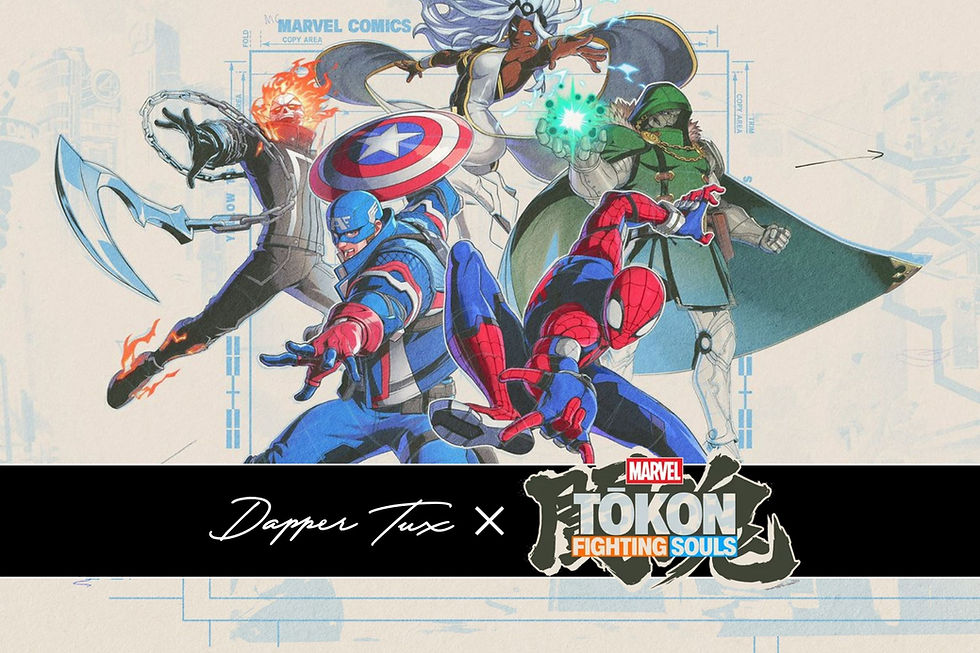
The art direction in Tōkon is fantastic and one of my favourite parts of the experience. Arc System Works has given every character a bold Japanese-inspired redesign without losing what makes them recognizable. Iron Man resembles a futuristic mecha, Wolverine looks suitably ferocious, and Peni Parker’s SP//dr towers over much of the cast.

A Dramatic Visual Language
The stage transitions are really well crafted too, sending opponents crashing into new comic-book panels. Where Ultimate Skills use dramatic camera angles, and even the menus carry the visual language of a graphic novel. I would have liked more stages at launch, but the available arenas are filled with Marvel references and background details.

Final thoughts on MARVEL Tōkon: Fighting Souls
MARVEL Tōkon: Fighting Souls is a confident return for Marvel fighting games. Its 4v4 system creates a satisfying sense of escalation, its controls welcome newcomers without abandoning competitive depth, and Episode Mode embraces Marvel’s comic-book roots in a way that feels authentic.
More stages, greater visual clarity and less repetition across the story campaigns would improve the package. Arc System Works has created something much more memorable than an existing fighter wearing Marvel costumes. Tōkon has its own style, rhythm and approach to team combat, and I can’t recommend it enough to Marvel and fighting fans alike.
MARVEL Tōkon: Fighting Souls Pros
+Spectacular anime and comic-book presentation
+Accessible combat backed by competitive depth
+Creative 4v4 team system
+Entertaining stories written by Kieron Gillen
+Excellent character variety and learning tools
MARVEL Tōkon: Fighting Souls Cons
-Limited selection of stages
-Fully assembled battles can become visually overwhelming
-Episode structure grows repetitive
MARVEL Tōkon: Fighting Souls Scoring
Category | Score |
Gameplay | 9/10 |
Graphics | 10/10 |
Sound | 9/10 |
Lasting Appeal / Replayability | 8/10 |
MARVEL Tōkon: Fighting Souls Overall Rating | 9/10 — 90% |
PlayStation provided a review copy of MARVEL Tōkon: Fighting Souls in order to conduct this review.
About the Author - Matthew "Dapper Tux" Rondina
Matthew has been involved in all things gaming since the 8-bit era. He is a video game and tech industry veteran who has been passionate about technology and gaming for over 20 years. In addition to being the Managing Editor of dappertux.com, he has bylines with Best Buy, Cineplex Entertainment, Mobile Syrup and Walmart. Follow Matthew’s gaming + tech adventures on multiple social platforms with the handle @dapper_tux via X, Instagram, Threads, TikTok, and join in on the fun!
dappertux.com uses affiliate links to provide a way for this website to earn advertising income. The blog may earn a referral commission on purchases made via these links.

Comments